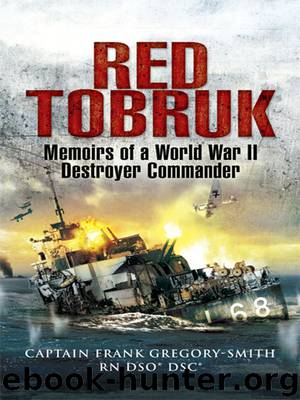
Red Tobruk: Memoirs of a World War II Destroyer Commander by Gregory Smith
Author:Gregory Smith [Smith, Gregory]
Language: eng
Format: azw3
Tags: HISTORY / Military / Naval, Bisac Code 1: HIS027150
ISBN: 9781844689620
Publisher: Pen and Sword
Published: 2009-04-21T04:00:00+00:00
CHAPTER SIX
The Hunt for U568
In May 1942, the great Admiral Andrew B Cunningham, ‘ABC’, that tough, determined, indomitable fighting leader, who had inspired the Fleet with his own courage and confidence during its grimmest ordeals, was relieved. To those who knew him only as the Commander in Chief and not personally, he seemed a formidable character but he was universally trusted and respected. He had been in command for so long that he had become an institution and his departure left a great, yawning gap which the Fleet feared would never be adequately filled. His relief was Admiral Sir Henry Hardwood, the victor of the Battle of the River Plate. His was a more gentle personality and one of his tasks, so it was rumoured, was to placate the RAF who were upset by his predecessor’s constant criticism of the lack of maritime air support.
Since February, the British Desert Army and Rommel’s forces had been more or less static on a line to the west of Tobruk, rebuilding their strength for a summer offensive, each hoping to strike the first blow. Thanks to the Axis blitz on Malta, the submarine and air offensive from that island had almost ceased so Rommel’s supplies were reaching him with little interference. Our only hope of winning the race for the offensive was to ensure that the tonnage carried by the Tobruk convoys exceeded that carried by Axis shipping. The enemy, of course, appreciated this and had steadily increased his own air and submarine offensive along the Tobruk tramlines. In spite of that HMS Eridge and HMS Beaufort lost only one ship out of the fifty or so escorted during April and May. In the third week of May, our convoy was attacked by fifteen Stuka dive bombers in the approaches to Tobruk. During the minute the attack lasted, the two destroyers fired more than one hundred four-inch shells. Thanks to that barrage, no ship was hit but those sixty seconds were amongst the most unpleasant in HMS Eridge’s career.
Our next convoy, in a bid to win the build-up battle, was one of the largest to sail for Tobruk. The ten supply ships, escorted by six corvettes and trawlers, reinforced by the destroyers HMS Hero, HMS Eridge and HMS Hurworth had a quiet passage for forty-eight hours. But, on the third morning, when approaching the coast of Cyrenaica, Tobruk began to broadcast a stream of red warnings. HMS Eridge was at action stations, everyone remembering the Stuka attack on our previous convoy and waiting tensely for a repetition.
Cox, the officer of the watch, was like everyone else, beginning to feel the strain of constant ‘Red Tobruks’. During his three months onboard, the ship must have received at least 100 alerts. Each one, even those not concerned with activity over the sea, had raised a niggle of anxiety which remained dormant until aroused and augmented by the next alert. This effect was cumulative and Cox was beginning to realise that his nerves were not quite so strong as they once had been.
Download
This site does not store any files on its server. We only index and link to content provided by other sites. Please contact the content providers to delete copyright contents if any and email us, we'll remove relevant links or contents immediately.
Waking Up in Heaven: A True Story of Brokenness, Heaven, and Life Again by McVea Crystal & Tresniowski Alex(37876)
Empire of the Sikhs by Patwant Singh(23139)
We're Going to Need More Wine by Gabrielle Union(19111)
Hans Sturm: A Soldier's Odyssey on the Eastern Front by Gordon Williamson(18653)
Leonardo da Vinci by Walter Isaacson(13414)
The Radium Girls by Kate Moore(12097)
Tools of Titans by Timothy Ferriss(8501)
Educated by Tara Westover(8120)
How to Be a Bawse: A Guide to Conquering Life by Lilly Singh(7551)
Permanent Record by Edward Snowden(5908)
The Last Black Unicorn by Tiffany Haddish(5687)
The Rise and Fall of Senator Joe McCarthy by James Cross Giblin(5319)
Promise Me, Dad by Joe Biden(5193)
The Wind in My Hair by Masih Alinejad(5142)
A Higher Loyalty: Truth, Lies, and Leadership by James Comey(5021)
The Crown by Robert Lacey(4869)
The Iron Duke by The Iron Duke(4409)
Joan of Arc by Mary Gordon(4160)
Stalin by Stephen Kotkin(4010)
